Student Access: Moodle | College Email

T: 01977 702139

reception@newcollpont.ac.uk

Textiles

Textiles

Why should I study Textiles?

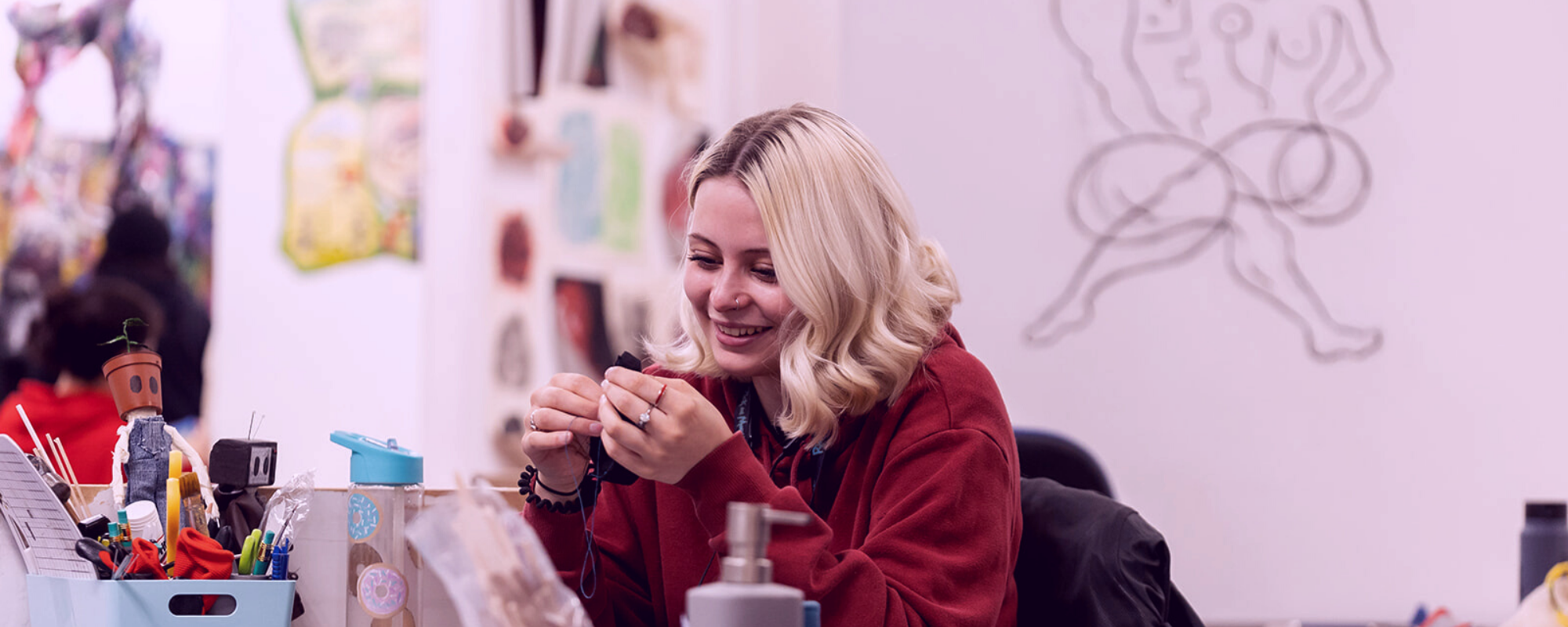
Textiles is a creative subject which aims to give you the confidence to explore your ideas even if you have never done Textiles. We challenge what Textiles is about and help you build upon your skills and learn techniques. We use what you would consider ‘normal’ textile stuff like wools and fabric but our students look at what is happening in the outside world where designers are using metal, wire, wood and anything else they can think about, but we do draw the line at fish! The coursework in Year 12 is based on the theme set by us but everybody will start to work in their own way as they discover what they can do using our specialist equipment. Soyou may try printed, constructed and find out what you are really good at because in the second year we will help you plan your own work.

What will I study?

AS Units

Unit 1: Coursework

This unit introduces you to a variety of ways of working such as fibre and material construction, felt and paper making, shibori, polyfusion, resist techniques, chemical and natural dyeing.

You will learn how to use information visually and apply historical and contextual studies to your work. Throughout the course you will explore material manipulation, evaluate your findings, learn how to present your work professionally and produce a concluding final piece. This represents 40% of the total AS Level mark.

Unit 2: Externally Set Assignment

This represents the conclusion of the skills and methods built up during the AS course. You are given a number of weeks to research and prepare a given topic for an eight hour practical examination. This represents 40% of the total AS Level mark.

A2 Units

Unit 3: Coursework

Practical - this allows you to research and analyse an area you have a particular interest in. This could be fine art, textiles, functional interior furnishings or fashion. The technical and aesthetic choices will be more sophisticated in terms of ideas and technical skill.

Visual essay - is an extended piece of writing between 100 and 300 words which directly links to your contextual coursework. This written work is presented in the visually exciting way which reflects and enhances the topic chosen. The practical and visual essay represent 30% of the total A Level mark.

Unit 4: Externally Set Assignment

This represents the culmination of the Advanced Textile Course. This will involve a number of weeks to prepare research and ideas given topic which will results in the production of a final piece within 12 hours. This represents 20% of the total A Level mark.

What are the entry requirements?

Normal college entry requirements plus GCSE Art or Textiles grade C would be desirable.
What skills do I need?

  • An enthusiasm for exploring colour and texture.
  • An ability to research, experiment and develop ideas visually.

How will I be taught?

The textiles course is taught using a variety of methods including demonstrations, discussions, individual exploration, group work and work sheets.

How is the course assessed?

Unit 1 & 3: are coursework units these are internally marked and externally moderated.
Units 2 & 4: are set by the examination board and are internally marked, internally standardised and externally moderated.

What will this course prepare me for?

Textile courses on both BA and BSc degree courses, fashion buying, fashion design, shoe design, interior design, surface pattern, interior textiles and floor coverings, media studies, fine art, window dressing, animation and teaching.

Private Study

As an approximate guideline AS subjects require 3-4 hrs of independent study each; AS2 subjects 4-5 hrs each and GCSE subjects 2hrs each.

What materials will I need to purchase?

A Textile pack, approximately £7.00, is available to purchase through the Payment Office.

Examining Board

EDEXCEL

Textiles is for you if

You enjoy manipulating materials, researching contemporary practitioners and developing your own ways of working.

Textiles is not for you if

You don't enjoy working practically and are not open to new ideas and learning to think independently.

« Back to Course Listing